CJC-1295 no DAC
Research Peptide
CJC-1295 no DAC
Alternative Name: Mod GRF 1-29, CJC-1295 without DAC, CJC-no DAC Sequence Length: 29 amino acid sequence
Molecular Structure
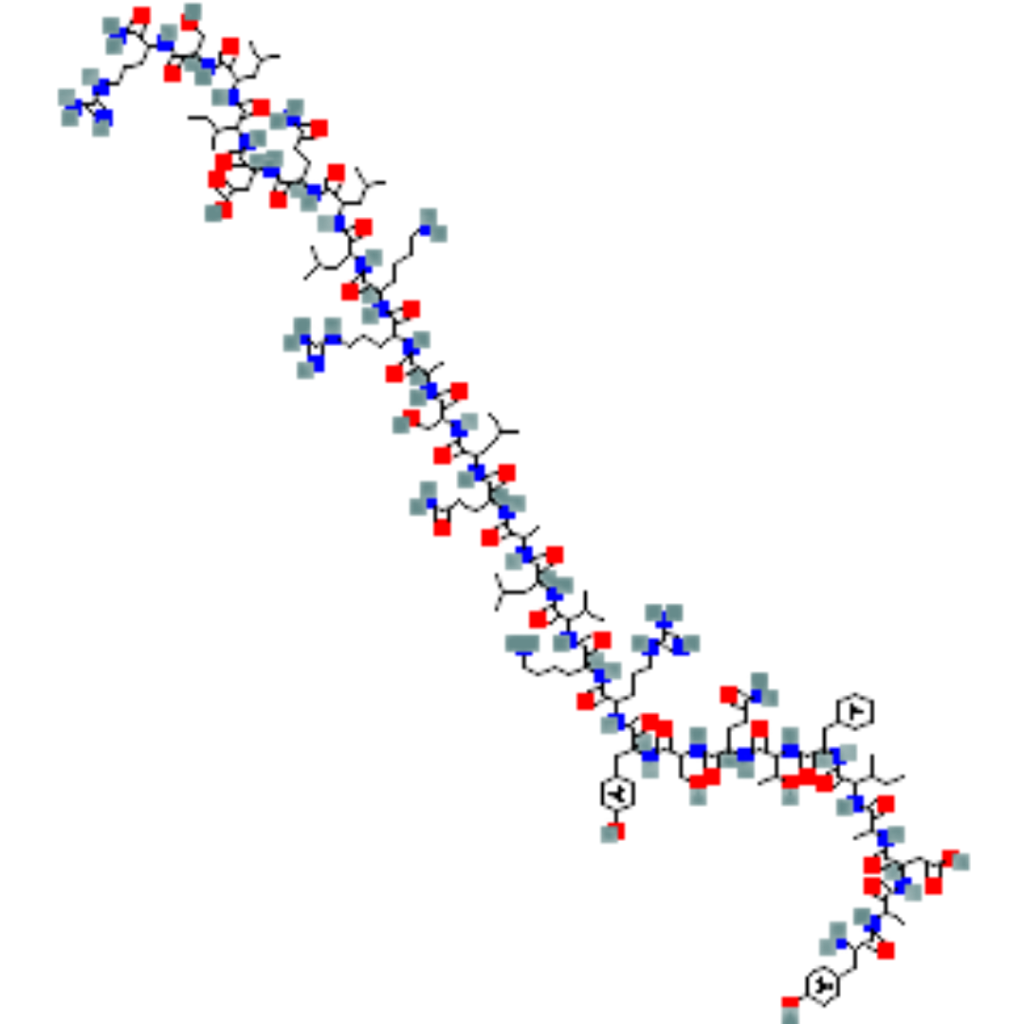
Chemical Properties
Molecular Mass: 3368.7 g/mol
Molecular Formula: C152H252N44O42
CAS Number: N/A
Sequence: Tyr-D-Ala-Asp-Ala-Ile-Phe-Thr-Gln-Ser-Tyr-Arg-Lys-Val-Leu-Ala-Gln-Leu-Ser-Ala-Arg-Lys-Leu-Leu-Gln-Asp-Ile-Leu-Ser-Arg-NH₂
Half-Life: approximatley 30 min.
Typical Purity: >98%
Administration Routes: subcutaneous
Overview
CJC-1295 No-DAC, also known as Mod GRF 1-29, is a synthetic peptide made up of 29 amino acids. It is based on the active portion of human Growth Hormone Releasing Hormone (GHRH 1-29) and includes four amino acid changes that help make it more stable by slowing its breakdown. Unlike CJC-1295 with Drug Affinity Complex (DAC), this version does not include an albumin-binding component, giving it a relatively short circulating half-life of about 30 minutes.
Researchers developed CJC-1295 No-DAC to create a more stable form of GHRH while keeping its period of receptor activity brief. Because it does not contain DAC, it produces a short period of receptor signaling that more closely resembles the body’s natural release of GHRH. This feature has made it a focus of preclinical research on growth hormone regulation, endocrine signaling, and receptor biology. Published laboratory and animal studies have examined how CJC-1295 No-DAC interacts with the growth hormone axis to better understand normal hormone signaling and communication between the hypothalamus and pituitary gland.
Research Use Only: CJC-1295 no DAC is intended exclusively for laboratory research and analytical purposes. It is an investigational research compound and has not been approved by the U.S. Food and Drug Administration (FDA).
Mechanism of Action
CJC-1295 No-DAC has been studied as a selective activator (agonist) of the Growth Hormone Releasing Hormone Receptor (GHRHR), which is found on specialized cells in the anterior pituitary gland. It was designed to closely resemble the body’s natural Growth Hormone Releasing Hormone (GHRH) while being more resistant to breakdown by enzymes. This increased stability comes from four amino acid substitutions.
When CJC-1295 No-DAC binds to the GHRH receptor, researchers have observed activation of several normal cellular signaling pathways. These include the Gs protein, adenylyl cyclase, and cyclic adenosine monophosphate (cAMP) pathway. Increased cAMP levels activate protein kinase A (PKA), which helps regulate gene activity, cell signaling, calcium movement, and normal hormone release. These pathways are well known for their role in pituitary cell function and endocrine signaling.
Unlike CJC-1295 with Drug Affinity Complex (DAC), CJC-1295 No-DAC does not contain an albumin-binding component. As a result, it remains in circulation for a much shorter time and produces only a brief period of receptor activation. Researchers have studied this short activity because it more closely resembles the body’s natural pulsatile GHRH signaling.
Published laboratory and animal studies have also examined how GHRH receptor signaling interacts with other hormone pathways involved in pituitary function. Current research focuses on receptor communication, cellular signaling, and feedback mechanisms that help regulate endocrine activity. Although many aspects of GHRH signaling are understood, additional research is needed to better explain how stabilized GHRH analogs such as CJC-1295 No-DAC influence these biological processes in experimental models.
Research Use Only: CJC-1295 no DAC is intended exclusively for laboratory research and analytical purposes. It is an investigational research compound and has not been approved by the U.S. Food and Drug Administration (FDA).
Frequently Asked Questions
- What is CJC-1295 No-DAC? CJC-1295 No-DAC, also known as Mod GRF 1-29, is a synthetic peptide derived from the first 29 amino acids of human Growth Hormone Releasing Hormone (GHRH). Four amino acid substitutions increase its stability while preserving its ability to bind the GHRH receptor. It has been widely studied in laboratory models investigating endocrine signaling and growth hormone physiology.
- What is the difference between CJC-1295 No-DAC and CJC-1295 with DAC? The primary difference is the presence of the Drug Affinity Complex (DAC). CJC-1295 with DAC contains an albumin-binding modification that greatly extends its circulation time. CJC-1295 No-DAC lacks this modification, resulting in a much shorter half-life and brief receptor activation that more closely resembles natural GHRH signaling.
- Why is it called Mod GRF 1-29? The name Modified GRF 1-29 reflects its design. It is based on the biologically active 29-amino-acid region of natural Growth Hormone Releasing Hormone (GHRH), with four amino acid substitutions introduced to improve resistance to enzymatic degradation.
- What receptor does CJC-1295 No-DAC target? Published research has investigated CJC-1295 No-DAC as a selective agonist of the Growth Hormone Releasing Hormone Receptor (GHRHR) located on somatotroph cells of the anterior pituitary. Activation of this receptor initiates intracellular signaling involved in normal endocrine regulation.
- What signaling pathways have been studied? Experimental studies have examined activation of the Gs protein–adenylyl cyclase–cAMP–protein kinase A (PKA) signaling pathway following GHRH receptor binding. Researchers continue to investigate how these molecular pathways regulate gene expression and endocrine signaling.
- Why has CJC-1295 No-DAC attracted scientific interest? Its short duration of activity makes it useful for studying pulsatile GHRH receptor signaling. Researchers have examined how brief receptor activation differs from prolonged stimulation in experimental models of endocrine physiology.
- What is the amino acid sequence of CJC-1295 No-DAC? CJC-1295 No-DAC is a 29-amino-acid peptide derived from the active region of human GHRH. Four amino acid substitutions improve stability while maintaining receptor affinity, making it suitable for laboratory investigation of GHRH signaling.
- How long does CJC-1295 No-DAC remain in circulation? Preclinical pharmacokinetic studies suggest a serum half-life of approximately 30 minutes. Because it lacks the Drug Affinity Complex (DAC), it is cleared much more rapidly than CJC-1295 with DAC.
- Has CJC-1295 No-DAC been studied with other research peptides? Yes. Published laboratory studies have investigated CJC-1295 No-DAC alongside other peptides that influence endocrine signaling, including ipamorelin, to examine interactions within the growth hormone regulatory axis. These investigations remain limited to experimental models.
- Is CJC-1295 No-DAC approved for medical use? CJC-1295 No-DAC remains an investigational research peptide. It has been studied in laboratory and clinical research settings to better understand GHRH receptor biology and endocrine signaling, but it is not approved by the U.S. Food and Drug Administration (FDA) for general medical use.
Research Use Only: CJC-1295 no DAC is intended exclusively for laboratory research and analytical purposes. It is an investigational research compound and has not been approved by the U.S. Food and Drug Administration (FDA).
Research Use Only
This information is provided for educational and scientific research purposes only. Products offered by Flatirons Research Co are intended strictly for laboratory and research use and are not intended for human or veterinary use, consumption, diagnosis, treatment, or prevention of disease. Nothing on this page constitutes medical advice, dosing guidance, or a recommendation for clinical use.