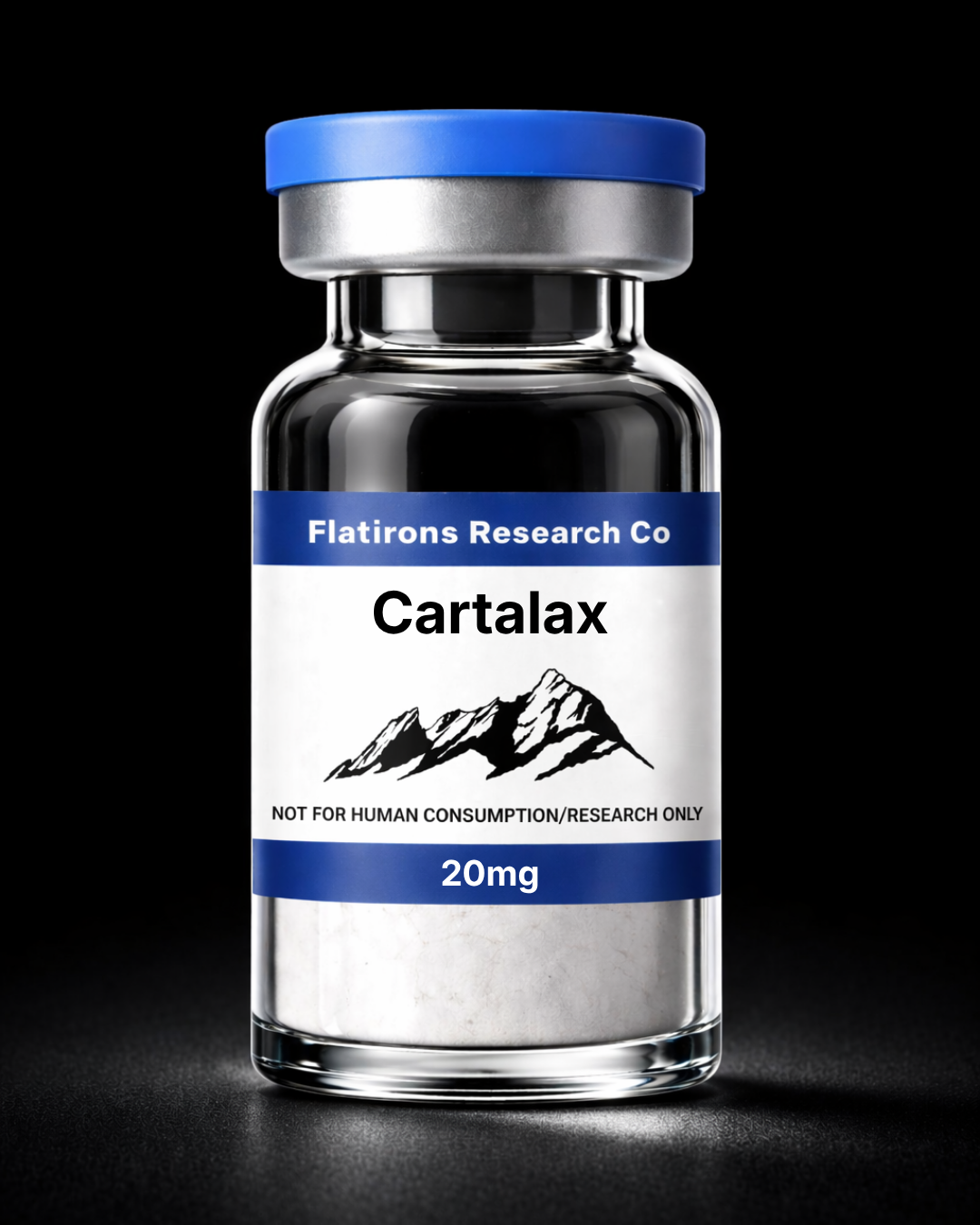
Cartalax, 20mg
$80.00
- Product Name: Cartalax
- Sequence: Ala-Glu-Asp
- Molecular Formula: C12H19N3O8
- Molecular Weight: 333.29 g/mol
- Research Only: Yes
- Form: Lyophilized Solid
- Purity: 99%
- Storage: Keep refrigerated upon reconstitution
Availability: 66 in stock
Bulk Pricing
- Buy 1 - 2 vials for $80.00 each
- Buy 3 - 4 vials for $76.00 each (5% off)
- Buy 5 - 7 vials for $72.00 each (10% off)
- Buy 8 - 11 vials for $70.40 each (12% off)
- Buy 12 - 15 vials for $68.00 each (15% off)
- Buy 16+ vials for $64.00 each (20% off)
We offer free shipping for orders over $400
Cartalax Description
Cartalax, also known as peptide AED (Ala-Glu-Asp), is a short peptide that has been investigated in laboratory and preclinical models for its effects on cellular aging, gene expression, fibroblast activity, cartilage cells, and renal cell function. Research has primarily focused on how AED influences cellular pathways associated with proliferation, apoptosis, extracellular matrix regulation, and age-related changes.
These findings remain investigational and should not be interpreted as evidence of therapeutic efficacy in humans.
Cartalax and Age-Related Skin Changes
Laboratory research has examined the effects of peptide AED on skin fibroblasts and molecular pathways associated with cellular aging. In experimental models, AED has been reported to influence matrix metalloproteinase-9 (MMP-9), an enzyme involved in extracellular matrix remodeling, as well as markers associated with cellular proliferation and regeneration, including Ki-67 and CD98hc. Researchers have also observed changes in caspase-3 activity, a protein involved in programmed cell death.
Additional experimental research has explored the ability of short peptides such as AED to interact with skin-associated cellular systems and influence extracellular matrix homeostasis, fibroblast activity, oxidative processes, and other biological pathways associated with age-related tissue changes.
These findings provide a basis for continued investigation of AED in experimental models of skin and cellular aging.
Cartalax and Renal Cell Research
Peptide AED has also been studied in experimental models involving kidney cells. Researchers have reported increased cellular proliferation and changes in the expression of several proteins associated with cellular senescence, including p16, p21, and p53. Changes in SIRT6, a protein involved in DNA maintenance, cellular metabolism, and aging-related processes, have also been reported.
Molecular studies have additionally investigated interactions between AED and DNA. Experimental findings suggest that AED may interact with specific DNA sequences within the minor groove, providing one possible mechanism through which short peptides could influence gene expression.
Comparative studies examining AED, peptide EDL, and kidney-derived polypeptide complexes have reported differences in their effects on cellular proliferation and apoptosis. While AED demonstrated measurable biological activity in these models, some kidney-derived peptide preparations produced stronger effects.
These findings support further laboratory investigation into the influence of AED on renal cell biology and age-associated cellular processes.
Cartalax and Cellular Aging
Researchers have investigated Ala-Glu-Asp (AED) and other short peptides in human mesenchymal stem-cell models designed to study cellular aging.
In one study, AED influenced the expression of genes associated with aging and cellular regulation. Researchers reported increased IGF1 expression in experimental aging models and changes in NF-κB expression, a signaling pathway involved in inflammation, cellular stress, and numerous other biological processes.
Differences in TERT expression were also observed between experimental aging models. TERT is associated with telomerase activity and telomere maintenance, making these observations relevant to laboratory research investigating mechanisms of cellular aging.⁵
Collectively, these findings suggest that AED can influence gene-expression patterns in experimental cell models and provide a basis for further research into short-peptide regulation of age-associated cellular pathways.
Cartalax and Neuronal Differentiation Research
Short peptides, including AED, have been investigated for their effects on cellular differentiation. Experimental research using human periodontal ligament stem cells has examined whether these peptides can influence neuronal differentiation and the expression of markers associated with neural cell development.
These findings may provide useful experimental models for studying peptide-mediated cellular differentiation and neurobiology. Additional research is required to determine the significance and reproducibility of these observations.
Cartalax and Cartilage Research
Cartalax has also been investigated in experimental models involving chondrocytes, the specialized cells responsible for maintaining cartilage tissue.
Preclinical research in young and aged animal models has reported changes in chondrocyte proliferation following exposure to peptide AED. These observations have led researchers to investigate the peptide’s potential influence on cartilage cell biology, tissue aging, and regenerative processes.
Further research is necessary to characterize the underlying mechanisms and determine the relevance of these findings beyond experimental models.
Research Summary
Laboratory and preclinical studies of Cartalax (AED) have investigated several areas of cellular biology, including:
- Fibroblast activity and extracellular matrix regulation
- Cellular proliferation and apoptosis
- Age-associated gene expression
- SIRT6, p16, p21, p53, IGF1, and NF-κB signaling
- Peptide-DNA interactions
- Renal cell biology
- Stem-cell differentiation
- Chondrocyte proliferation and cartilage biology
Current findings are primarily derived from in vitro, cellular, and animal research. Further investigation is necessary to establish the biological significance, reproducibility, and potential applications of these findings.
Cartalax is not approved by the U.S. Food and Drug Administration for human use. Its safety, efficacy, and pharmacological profile have not been established in approved FDA clinical trials. This compound is intended strictly for laboratory research purposes and is not for human or veterinary use.
Lyophilized Peptides
These peptides are freeze-dried, a process that not only extends shelf life but also preserves the purity and integrity of the peptides during storage.
Disclaimer: For Research Purposes only
This content is provided strictly for research purposes and does not constitute an endorsement or recommendation for the non-laboratory application or improper handling of peptides designed for research. The information, including discussions about specific peptides and their researched benefits, is presented for informational purposes only and must not be construed as health, clinical, or legal guidance, nor an encouragement for non-research use. Peptides described here are solely for use in structured scientific study by authorized individuals. We advise consulting with research experts, medical practitioners, or legal counsel prior to any decisions about obtaining or utilizing these peptides. The expectation of responsible, ethical utilization of this information for legitimate investigative and scholarly objectives is paramount. This notice is dynamic and governs all provided content on research peptides.