Research Peptide
GHK-Cu
Alternative Name: Copper Peptide, GHK Copper, Copper tripeptide-1, GHKCu
Sequence Length: 3 amino acid sequence
Molecular Structure
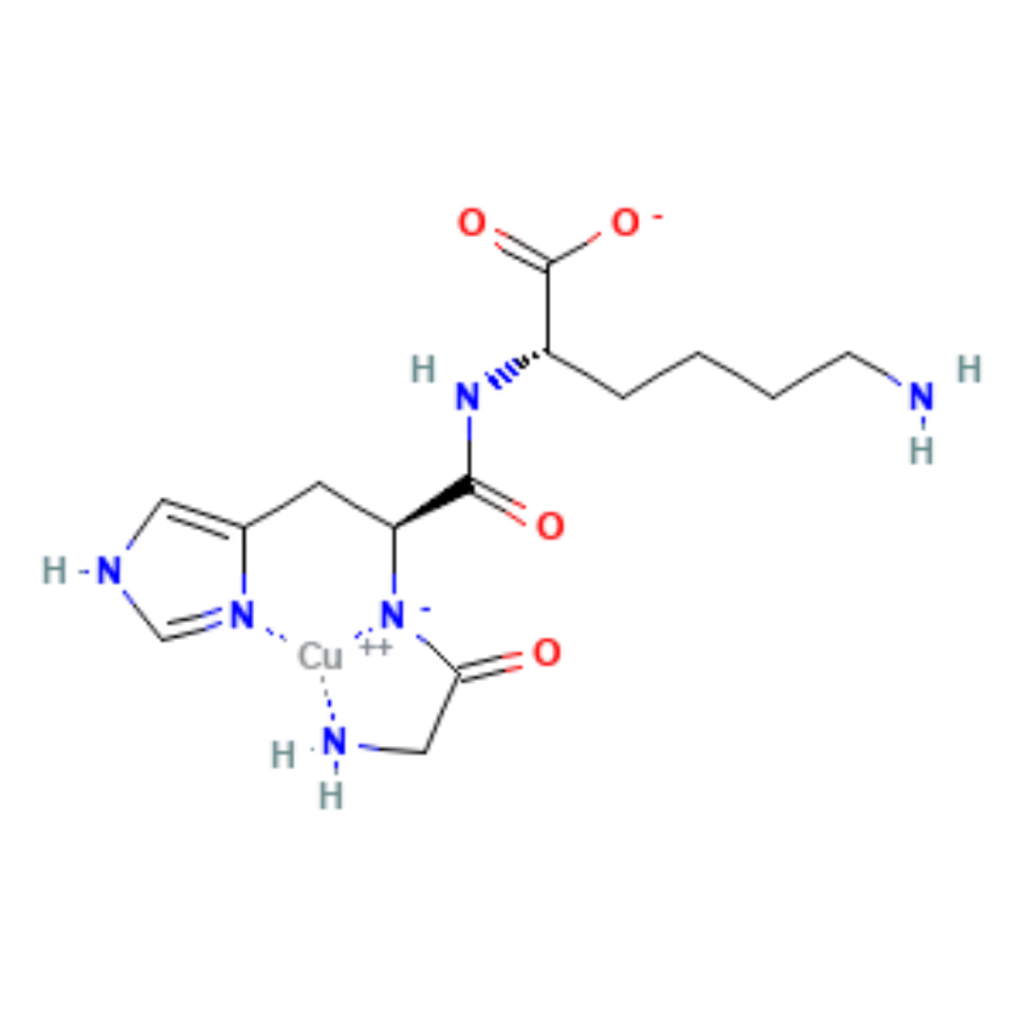
Chemical Properties
Molecular Mass: 401.91 g/mol
Molecular Formula: C14H22CuN6O4
CAS Number: 49557-75-7
Sequence: Gly-His-Lys
Half-Life: approximately 30-60 minutes
Typical Purity: >98%
Overview
GHK-Cu is a naturally occurring copper-binding peptide complex that has been studied for its role in cellular signaling, copper transport, gene expression, extracellular matrix regulation, and tissue remodeling. GHK stands for glycyl-L-histidyl-L-lysine, a small peptide made of three amino acids: glycine, histidine, and lysine. When GHK binds a copper ion (Cu²⁺), it forms the complex commonly known as GHK-Cu.
Discovery and Natural Occurrence
GHK was first identified in human plasma in the early 1970s. Researchers later found that the peptide has a strong ability to bind copper ions. GHK and related copper-bound forms have since been studied in biological fluids, including plasma, saliva, and urine. Because GHK occurs naturally in biological systems, researchers became interested in understanding why such a small peptide would have a strong attraction to copper and what role this interaction might play in cellular biology. GHK is particularly interesting because it contains only three amino acids. Despite its small size, its chemical structure allows it to form a stable complex with copper.
Why Does GHK Bind Copper?
The histidine amino acid in GHK plays an important role in copper binding. Histidine contains nitrogen atoms that can interact with metal ions. Other parts of the GHK molecule also participate in holding the copper ion in place. This type of interaction is known as metal coordination. Rather than forming a simple chemical bond at one location, several parts of the peptide interact with the same copper ion and help hold it in a specific position. A simple way to picture this is to think of GHK as a small molecular holder for copper. The peptide surrounds and coordinates the copper ion, forming the GHK-Cu complex. This property has led researchers to examine whether GHK may participate in the movement, exchange, or availability of copper within biological systems.
Why Is Copper Important in Biology?
Copper is a trace element, meaning biological systems require only small amounts of it. However, those small amounts are important because copper participates in the activity of many proteins and enzymes. Some enzymes require a metal ion to function correctly. The metal acts as a cofactor, which means it helps the enzyme perform its chemical reactions. Copper-dependent enzymes are involved in processes such as cellular energy production, oxidation-reduction reactions, connective tissue chemistry, and molecular signaling. At the same time, free copper ions can participate in chemical reactions that need to be carefully controlled. For this reason, biological systems use proteins and other molecules to bind, transport, store, and exchange copper. GHK-Cu has attracted scientific interest partly because GHK may provide one way for copper to interact with biological molecules in a controlled form. Researchers continue to investigate how important this function is under normal biological conditions.
GHK-Cu and Cellular Signaling
Research into GHK-Cu has expanded well beyond its ability to bind copper. Published studies have examined GHK and GHK-Cu in relation to cellular signaling and gene expression. Gene expression is the process cells use to control which genes are active and how much of a particular protein is produced. Rather than being associated with one clearly established receptor and one signaling pathway, GHK-Cu has been investigated across a much broader group of cellular processes. Researchers have reported changes involving genes and proteins connected with extracellular matrix regulation, oxidative processes, inflammatory signaling, cell communication, and tissue remodeling. The exact relationship between GHK-Cu and these different pathways is still being investigated. It is not yet clear whether all reported changes result directly from the peptide, from its copper-binding properties, or from a combination of several molecular interactions.
GHK-Cu and the Extracellular Matrix
One major area of GHK-Cu research involves the extracellular matrix, often shortened to ECM. The extracellular matrix is the network of proteins and other molecules surrounding cells. It can be thought of as the structural framework around cells. It provides physical support while also helping cells communicate with their surrounding environment. Important components of the extracellular matrix include collagen, elastin, glycoproteins, and glycosaminoglycans. The matrix is not a permanent structure. Cells continually build, break down, and reorganize its components. Researchers have examined GHK-Cu in experimental models involving both the production and breakdown of extracellular matrix components. This includes research involving fibroblasts, which are cells that produce many of the proteins found in the extracellular matrix. Studies have also examined GHK-Cu in relation to matrix metalloproteinases (MMPs). MMPs are enzymes that break down certain extracellular matrix proteins. This breakdown is part of normal matrix turnover and remodeling. Because both construction and breakdown are necessary for proper matrix organization, researchers are interested in how GHK-Cu may participate in the signaling systems that regulate this balance.
Oxidative and Cellular Processes
GHK-Cu has also been investigated in experimental models involving oxidative processes. Oxidation is a normal part of cellular chemistry. During many chemical reactions, molecules called reactive oxygen species (ROS) can be produced. Cells contain several systems that control these molecules and maintain chemical balance. Copper is particularly important in this area because it can participate in oxidation-reduction reactions. Researchers have therefore examined whether binding copper to GHK changes how the metal interacts with surrounding molecules. Studies have also investigated GHK-Cu in connection with proteins and signaling pathways involved in cellular responses to oxidative conditions. The exact mechanisms remain an active area of research.
Why GHK-Cu Is Studied
GHK-Cu is scientifically interesting because it combines two biologically important components: a naturally occurring peptide and a copper ion. Research suggests that its biological activity cannot be explained by a single receptor or pathway. Instead, researchers have examined GHK-Cu across several connected areas of biology, including:
- Copper binding and transport
- Gene expression
- Cellular signaling
- Extracellular matrix regulation
- Fibroblast activity
- Matrix metalloproteinases
- Oxidation-reduction chemistry
- Cellular remodeling processes
This makes GHK-Cu different from peptides that primarily function by binding to one specific receptor. Current evidence suggests that GHK-Cu may participate in a broader network of molecular interactions involving both the GHK peptide and the copper ion it carries.
Although GHK-Cu has been studied for several decades, its complete biological mechanism has not been fully characterized. Many findings come from cell cultures, biochemical experiments, and other experimental models. Additional research is needed to determine how its different molecular interactions are connected and to better define the biological role of the GHK-Cu complex.
Research Use Only: GHK-Cu is intended exclusively for laboratory research and analytical purposes. It is an investigational research compound and has not been approved by the U.S. Food and Drug Administration (FDA).
Mechanism of Action
The mechanism of GHK-Cu appears to involve several connected biological processes rather than one specific receptor or signaling pathway. Research has focused mainly on its ability to bind and transport copper, influence gene expression, interact with fibroblasts, and regulate the extracellular matrix (ECM). Unlike some peptides that work by attaching to a specific receptor on the outside of a cell, GHK-Cu does not have one clearly established receptor that explains all of its biological activity. Instead, researchers have proposed that its effects come from a combination of the GHK peptide, the copper ion it carries, and changes in cellular signaling.
GHK Binds Copper
The first step in understanding GHK-Cu is its interaction with copper (Cu²⁺). GHK has a strong natural attraction to copper ions. Several parts of the peptide, especially the amino acid histidine, contain nitrogen atoms that can interact with copper and hold it in place.
This process is called metal coordination.
A simple way to picture it is:
GHK + Cu²⁺ → GHK-Cu
GHK acts somewhat like a small molecular carrier that can bind a copper ion. Researchers have proposed that this may allow GHK to participate in the movement and exchange of copper between molecules. This is important because copper is used by many enzymes. These are known as copper-dependent enzymes, meaning they require copper as a helper, or cofactor, to carry out certain chemical reactions. However, GHK-Cu should not simply be viewed as a copper delivery system. Research suggests that the complete GHK-Cu complex may participate in additional forms of cellular signaling.
GHK-Cu and Fibroblasts
One of the main cell types examined in GHK-Cu research is the fibroblast. Fibroblasts are cells responsible for producing and organizing many of the materials that make up the extracellular matrix. The extracellular matrix, or ECM, is the network surrounding cells. It contains structural molecules such as:
- Collagen
- Elastin
- Glycosaminoglycans
- Proteoglycans
- Other supporting proteins
The ECM can be thought of as the framework surrounding cells. However, it is not simply a fixed structure. Cells are constantly building, removing, and reorganizing parts of it. Laboratory studies using cultured fibroblasts have examined changes in collagen and other extracellular matrix components following exposure to GHK-Cu. This has made fibroblast signaling and ECM regulation major areas of GHK-Cu research.
Building and Breaking Down the Extracellular Matrix
One of the more interesting parts of GHK-Cu biology is that researchers have examined it in connection with both the production and breakdown of extracellular matrix components. At first, building and breaking down the matrix may sound like opposite processes. In reality, both are necessary for matrix remodeling.
Imagine remodeling a building. Old or damaged material must first be removed. New material can then be produced and organized in its place.
Cells perform a similar process with the extracellular matrix.
Research involving GHK-Cu has examined the production of molecules such as collagen and glycosaminoglycans. At the same time, researchers have also studied its relationship with enzymes responsible for breaking down existing matrix proteins. This suggests that GHK-Cu research is not simply about producing more extracellular matrix. It is also about understanding how the matrix is continually reorganized and regulated.
Matrix Metalloproteinases — MMPs
An important group of enzymes in this process is called matrix metalloproteinases, or MMPs. MMPs act somewhat like molecular cutting tools. They break apart specific proteins within the extracellular matrix so that old material can be removed and the surrounding structure can be reorganized. For example, researchers studying cultured fibroblasts found that GHK-Cu increased the expression of MMP-2, an enzyme involved in extracellular matrix turnover. Interestingly, the same study found increases in molecules that regulate MMP activity. This is important because matrix remodeling requires control. Too little breakdown would make it difficult to reorganize the matrix, while uncontrolled breakdown could disrupt its structure.
TIMPs Help Control MMPs
Cells therefore produce another group of molecules called tissue inhibitors of metalloproteinases, or TIMPs. TIMPs help regulate MMP activity.
A simple way to remember the relationship is:
MMPs = cutting tools
TIMPs = controls on the cutting tools
Research involving fibroblast cultures has found changes in MMP-2, TIMP-1, and TIMP-2 following exposure to GHK-Cu. Researchers therefore study GHK-Cu not simply for its relationship with matrix production, but for how it may participate in the balance between building, breaking down, and reorganizing the extracellular matrix.
GHK-Cu and Gene Expression
Another major area of research involves gene expression. Every cell contains thousands of genes, but cells do not use every gene at the same time. Gene expression is the process that determines which genes are active, which proteins are produced, and how the cell responds. Research using large gene-expression databases has suggested that GHK may be associated with changes in the activity of numerous genes rather than one single pathway. These genes include groups associated with extracellular matrix regulation, cellular stress, antioxidant systems, and other biological processes.This is one reason the mechanism of GHK-Cu is difficult to describe as a simple receptor pathway.
Instead of:
Peptide → one receptor → one response
the research suggests a broader model:
GHK binds copper → GHK-Cu interacts with cellular systems → signaling and gene expression change → multiple proteins and cellular processes may be affected
Exactly how GHK-Cu produces all of these gene-expression changes has not been fully established.
Copper-Dependent Cellular Processes
The copper carried by GHK-Cu may also contribute to its biological activity. Copper acts as a cofactor for several enzymes. For example, copper is required by lysyl oxidase (LOX), an enzyme involved in forming connections between collagen and elastin molecules. These connections are called cross-links. They help organize structural proteins within the extracellular matrix. Copper also participates in oxidation-reduction chemistry and other enzyme systems. Researchers therefore continue to investigate how much of GHK-Cu’s observed biological activity comes from the GHK peptide itself, how much comes from copper, and how much depends on the two working together as the GHK-Cu complex.
Oxidative and Inflammatory Signaling
GHK-Cu has also been investigated in experimental models involving reactive oxygen species (ROS) and inflammatory signaling pathways. ROS are chemically reactive molecules produced during normal cellular activity. Cells normally maintain systems that keep ROS production and removal in balance. Because copper can participate in oxidation-reduction reactions, controlling how copper interacts with surrounding molecules is important. Researchers have examined GHK-Cu in connection with antioxidant enzymes and signaling pathways associated with cellular responses to oxidative conditions. Some experimental research has also examined pathways involving NF-κB and MAPK signaling, although the importance and directness of these interactions remain under investigation. It is therefore more accurate to say that GHK-Cu has been investigated in relation to these pathways than to describe it as directly controlling a single oxidative or inflammatory pathway.
Putting the Mechanism Together
GHK-Cu can be thought of as a multi-target copper-peptide signaling complex. Its proposed mechanism can be simplified into the following sequence:
GHK binds Cu²⁺ → GHK-Cu forms → The complex participates in copper-dependent and cellular signaling processes → Changes in gene and protein expression are observed → Fibroblasts and extracellular matrix pathways are affected → Collagen, glycosaminoglycans, MMPs, TIMPs, and other matrix-related molecules are regulated → Extracellular matrix remodeling can be studied
This is different from a peptide that has one known receptor and one clearly defined signaling pathway. Current research suggests that GHK-Cu participates in a network of molecular processes involving copper coordination, gene expression, enzyme activity, fibroblast signaling, and extracellular matrix regulation. However, researchers have not yet identified a single mechanism that explains all of the biological activity reported for GHK-Cu. For this reason, GHK-Cu’s mechanism should be considered multi-target and not yet fully characterized. Additional research is needed to determine which molecular interactions are direct effects of GHK-Cu and which occur farther downstream as part of broader cellular signaling.
Research Use Only: GHK-Cu is intended exclusively for laboratory research and analytical purposes. It is an investigational research compound and has not been approved by the U.S. Food and Drug Administration (FDA).
Research Papers
Fu, S.-C., Cheuk, Y.-C., Chiu, W.-Y.V., Yung, S.-H., Rolf, C.G. and Chan, K.-M. (2015), Tripeptide–copper complex GHK-Cu (II) transiently improved healing outcome in a rat model of ACL reconstruction. J. Orthop. Res., 33: 1024-1033. https://doi.org/10.1002/jor.22831
Related Compounds and Research Pathways
Research Context: Compounds listed below share areas of scientific investigation or molecular signaling. Inclusion does not indicate compatibility, combined use, or a recommendation to combine research compounds. Relationships describe similarities or differences reported in published research.
Overlapping Research Pathways:
- BPC-157: GHK-Cu and BPC-157 have both been studied in research involving cell movement, blood vessel signaling, tissue structure, and extracellular matrix activity. BPC-157 research has focused on vascular signaling, fibroblast activity, and connective tissue processes, while GHK-Cu has been investigated for gene expression, copper-dependent signaling, collagen regulation, and extracellular matrix remodeling. These compounds share several areas of cellular research but appear to influence them through different biological pathways.
- TB-500: GHK-Cu and TB-500 have both been studied in research involving cell movement, tissue structure, and extracellular matrix processes. TB-500 research has focused on actin regulation, cell migration, and cytoskeletal organization, while GHK-Cu has been investigated for gene expression, cellular signaling, collagen regulation, and extracellular matrix remodeling. These compounds overlap in several areas of tissue and cellular research but appear to act through different proposed mechanisms.
Related Research Areas:
- LL-37: GHK-Cu and LL-37 have both been studied in research involving cell signaling, cell movement, inflammatory pathways, and tissue remodeling. LL-37 research has focused on innate immune signaling, antimicrobial activity, cell migration, and inflammatory responses, while GHK-Cu has been investigated for gene expression, copper-dependent signaling, extracellular matrix regulation, and collagen-related processes. These compounds share several areas of cellular and tissue research but appear to influence them through different biological mechanisms.
- Epithalon: GHK-Cu and Epithalon have both been studied in research involving gene regulation, cellular aging, oxidative processes, and cellular function. Epithalon research has focused on gene expression, telomerase activity, telomere-related processes, and cellular aging models, while GHK-Cu has been investigated for gene expression, copper-dependent signaling, oxidative balance, and extracellular matrix regulation. These compounds share related areas of cellular research but have been investigated through different proposed mechanisms.
Opposing Pathways:
N/A
Frequently Asked Questions
1. What is GHK-Cu?
GHK-Cu is a naturally occurring copper-binding peptide complex. GHK stands for glycyl-L-histidyl-L-lysine, which is a peptide made from three amino acids: glycine, histidine, and lysine. When GHK binds a copper ion (Cu²⁺), the resulting complex is called GHK-Cu. Researchers have studied GHK-Cu because of its relationship with copper transport, cellular signaling, gene expression, fibroblast activity, and extracellular matrix regulation.
2. What does the “Cu” in GHK-Cu mean?
Cu is the chemical symbol for copper. In GHK-Cu, the GHK peptide binds a copper ion, usually represented as Cu²⁺. The peptide acts as a small molecular holder for the copper ion. This interaction is called metal coordination. Copper is an important trace element that serves as a cofactor for many enzymes, so researchers are interested in how GHK may influence the way copper interacts with biological systems.
3. Is GHK-Cu naturally occurring?
Yes. GHK is a naturally occurring peptide that was first identified in human plasma in the early 1970s. GHK and copper-associated forms have also been studied in biological fluids such as plasma, saliva, and urine. Laboratory-produced GHK-Cu allows researchers to study the chemical and biological properties of this naturally occurring peptide-copper system under controlled experimental conditions.
4. How does GHK-Cu work?
GHK-Cu does not appear to operate through one clearly identified receptor or signaling pathway. Instead, researchers have investigated a broader mechanism involving copper coordination, cellular signaling, gene expression, enzyme activity, fibroblasts, and extracellular matrix regulation.
The basic research model can be simplified as:
GHK binds Cu²⁺ → GHK-Cu forms → cellular and copper-dependent processes are influenced → changes in signaling and gene expression are observed.
The complete mechanism has not yet been established, and additional research is needed.
5. What is the extracellular matrix, and why is it important in GHK-Cu research?
The extracellular matrix (ECM) is a network of proteins and other molecules surrounding cells. It contains materials such as collagen, elastin, glycosaminoglycans, and proteoglycans. The ECM can be thought of as the structural framework around cells. However, it is constantly being built, broken down, and reorganized. Researchers have studied GHK-Cu in experimental models involving the production, breakdown, and organization of extracellular matrix components. This process is known as matrix remodeling.
6. What are fibroblasts, and what is their connection to GHK-Cu?
Fibroblasts are cells that produce and organize many components of the extracellular matrix. They produce molecules such as collagen and other structural materials surrounding cells. Fibroblasts also release enzymes and signaling molecules involved in controlling how the extracellular matrix is reorganized. Because of these functions, cultured fibroblasts are commonly used in GHK-Cu research. Researchers have examined how exposure to GHK-Cu is associated with changes in fibroblast signaling, gene expression, and extracellular matrix activity.
7. What are MMPs, and how are they related to GHK-Cu research?
Matrix metalloproteinases (MMPs) are enzymes that break down specific proteins within the extracellular matrix. They can be thought of as molecular cutting tools. Cells use these enzymes during normal extracellular matrix turnover and remodeling. Researchers have examined GHK-Cu in relation to MMP activity and expression, including MMP-2. Studies have also examined molecules called TIMPs, or tissue inhibitors of metalloproteinases, which help regulate MMP activity. This research suggests that GHK-Cu may be associated with systems involved in balancing the construction and breakdown of extracellular matrix components.
8. Does GHK-Cu affect gene expression?
Researchers have investigated GHK and GHK-Cu in relation to gene expression, which is the process cells use to control which genes are active and which proteins are produced. Experimental research has reported changes involving genes associated with extracellular matrix regulation, cellular signaling, oxidative processes, and other biological functions. However, the exact pathway responsible for these changes has not been fully identified. It remains unclear which changes are caused directly by GHK-Cu and which occur farther downstream as part of larger cellular signaling networks.
9. Why is copper important to GHK-Cu research?
Copper is a trace element that acts as a cofactor for many enzymes. A cofactor is a substance an enzyme needs to perform certain chemical reactions. For example, copper is required by lysyl oxidase (LOX), an enzyme involved in forming connections between collagen and elastin molecules. Copper also participates in oxidation-reduction chemistry and several other cellular processes. Because GHK strongly binds copper, researchers have investigated whether the peptide participates in the binding, transport, exchange, or availability of copper within biological systems.
10. Is the mechanism of GHK-Cu fully understood?
No. Although GHK-Cu has been studied for several decades, researchers have not identified one mechanism that explains all of its reported biological activity. Current research suggests that GHK-Cu may interact with several connected systems involving copper coordination, gene expression, fibroblast signaling, extracellular matrix remodeling, MMP and TIMP regulation, enzyme activity, and oxidative signaling. Many findings come from cell cultures, biochemical experiments, and other experimental models. Additional research is needed to determine which molecular interactions are direct effects of GHK-Cu and how these different pathways are connected.
Research Use Only: BPC-157 is intended exclusively for laboratory research and analytical purposes. It is an investigational research compound and has not been approved by the U.S. Food and Drug Administration (FDA).
Research Use Only
This information is provided for educational and scientific research purposes only. Products offered by Flatirons Research Co are intended strictly for laboratory and research use and are not intended for human or veterinary use, consumption, diagnosis, treatment, or prevention of disease. Nothing on this page constitutes medical advice, dosing guidance, or a recommendation for clinical use.