Research Peptide
BPC-157
Alternative Name: Body Protection Compound -157
Sequence Length: 15 amino acid sequence Source: Gastric Juice Protein
Molecular Structure
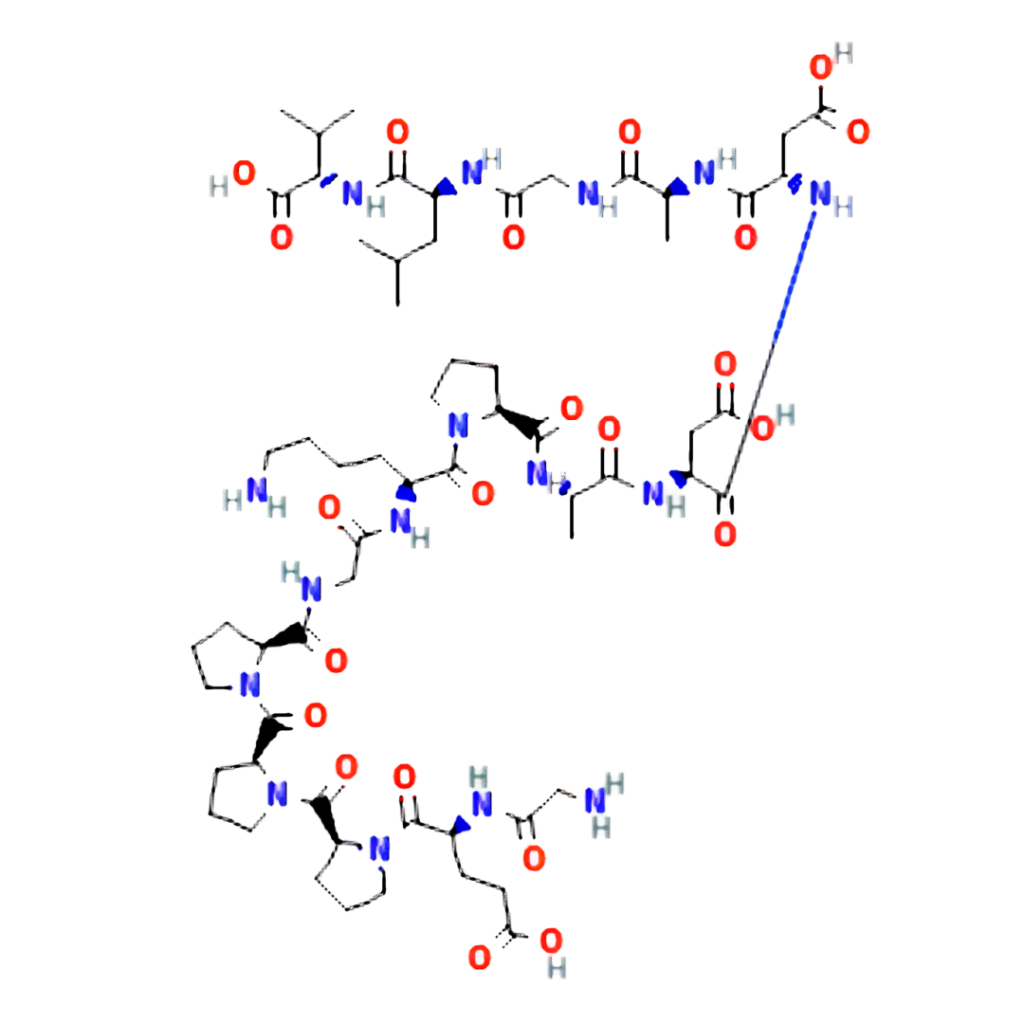
Chemical Properties
Molecular Mass: 1419.56 g/mol
Molecular Formula: C62H98N16O22
CAS Number: 137525-51-0
Sequence: Gly-Glu-Pro-Pro-Pro-Gly-Lys-Pro-Ala-Asp-Asp-Ala-Gly-Leu-Val
Half-Life: Preclinical studies suggest a short plasma half-life of less than 30 minutes. Despite being cleared quickly from the bloodstream, biological effects observed in research may persist much longer. Full human pharmacokinetic data have not yet been published.
Typical Purity: >98%
Administration Routes: Subcutaneous, Oral, Intraperitoneal, Intravenous
Overview
BPC-157 (Body Protection Compound-157) is a synthetic pentadecapeptide composed of 15 amino acids with the sequence Gly-Glu-Pro-Pro-Pro-Gly-Lys-Pro-Ala-Asp-Asp-Ala-Gly-Leu-Val. It has a molecular weight of approximately 1,419.5 g/mol and is identified by CAS No. 137525-51-0. BPC-157 is commonly described as a stable gastric peptide because preclinical research suggests it remains relatively stable under acidic conditions. This characteristic has made it a frequent subject of laboratory investigations examining peptide stability and multiple experimental routes of administration.
Research Background
Most published research involving BPC-157 has been conducted in laboratory and animal models. Experimental studies have investigated its role in several areas of research, including:
Tissue repair and regeneration
Tendon and ligament biology
Gastrointestinal tissue research
Wound-healing models
Peripheral nerve research
Cardiovascular signaling
Angiogenesis (blood vessel formation)
One of the most extensively studied areas involves connective tissue. In experimental tendon injury models, researchers have evaluated BPC-157’s influence on tissue organization, collagen remodeling, and tendon recovery following injury. BPC-157 has also been examined in preclinical models of gastrointestinal injury, including studies involving chemically induced inflammation and experimentally produced gastric lesions.
Research Status
Current knowledge of BPC-157 is derived primarily from laboratory and preclinical investigations. While a limited number of early human studies have been reported in the scientific literature, additional well-controlled clinical research is necessary to better understand its pharmacology, safety profile, and biological activity. Findings observed in laboratory or animal models should not be assumed to produce similar results in other experimental settings.
Regulatory Status
BPC-157 is not approved by the U.S. Food and Drug Administration (FDA) for the diagnosis, treatment, cure, or prevention of any disease.
It is also included on the World Anti-Doping Agency (WADA) Prohibited List under S0: Non-Approved Substances.
Laboratory Storage
BPC-157 is commonly supplied as a lyophilized (freeze-dried) peptide for laboratory research.
Storage recommendations may vary depending on formulation and manufacturer. Researchers should follow the storage and handling guidance provided with the specific material to maintain product stability and integrity throughout laboratory use.
Research Use Only: BPC-157 is intended exclusively for laboratory research and analytical purposes. It is an investigational research compound and has not been approved by the U.S. Food and Drug Administration (FDA).
Mechanism of Action
The biological mechanism of BPC-157 has not been fully characterized. Current research suggests that the peptide interacts with multiple cellular signaling pathways rather than acting through a single, well-defined receptor. Investigators have examined its influence on pathways involved in vascular signaling, intracellular communication, oxidative stress responses, and normal cellular repair processes.
One of the most extensively studied areas involves vascular endothelial growth factor receptor-2 (VEGFR2) signaling and nitric oxide (NO) regulation. Experimental models suggest that BPC-157 may enhance activation of the PI3K/Akt/endothelial nitric oxide synthase (eNOS) pathway, increasing nitric oxide production within endothelial cells. Researchers have also examined Src kinase and caveolin-1 signaling, which may contribute to eNOS activation and regulation of vascular homeostasis. These molecular pathways have been investigated because of their roles in endothelial cell biology, vascular function, and cellular communication.
Published studies have also examined activation of the extracellular signal-regulated kinase (ERK1/2) pathway. In endothelial cell models, ERK1/2 signaling has been associated with increased cellular proliferation, migration, and formation of vascular structures. Downstream activation of transcription factors including c-Fos, c-Jun, EGR-1, and NAB2 has also been reported, suggesting that BPC-157 may influence gene expression involved in normal cellular responses.
Additional research has investigated the peptide’s interactions with oxidative stress pathways. Experimental findings suggest that BPC-157 may increase expression of cytoprotective proteins such as heme oxygenase-1 (HO-1) while supporting mitochondrial integrity and limiting oxidative stress signaling. Researchers have proposed that these molecular responses contribute to broader cellular adaptations observed during preclinical investigation.
BPC-157 has also been studied in experimental models of nervous system biology. Published research has examined its effects on neurotransmitter signaling involving dopamine, serotonin, gamma-aminobutyric acid (GABA), glutamate, and acetylcholine receptor function. These investigations suggest that the peptide may influence normal neuronal signaling pathways and neuromuscular communication, although the underlying molecular interactions remain incompletely understood.
Researchers have further investigated BPC-157 in studies of fibroblast biology, extracellular matrix regulation, and angiogenic signaling. Experimental models have examined focal adhesion kinase (FAK)-paxillin signaling, collagen-related pathways, macrophage polarization, inflammatory signaling molecules, and vascular growth mechanisms. Together, these observations suggest that BPC-157 influences several interconnected molecular networks rather than a single biological target.
Overall, current evidence indicates that BPC-157 exhibits complex biological activity involving multiple signaling pathways associated with vascular biology, cellular communication, oxidative stress regulation, and connective tissue physiology. Because many of these findings originate from cell-based and animal studies, additional research is needed to clarify its molecular targets, receptor interactions, and biological mechanisms.
Research Use Only: BPC-157 is intended exclusively for laboratory research and analytical purposes. It is an investigational research compound and has not been approved by the U.S. Food and Drug Administration (FDA).
Research Papers
Gwyer D, Wragg NM, Wilson SL
Cell Tissue Res. 2019 Aug;377(2):153-159. doi: 10.1007/s00441-019-03016-8. Epub 2019 Mar 27.PMID: 30915550
Yuan C, Demers A, Silva-Ortiz V, Hasoon JJ, Lee W, Dave K, Amirdelfan K, Burke HW, Christo PJ, Robinson CL.
Int J Mol Sci. 2026 Mar 22;27(6):2876. doi: 10.3390/ijms27062876.
PMCID: PMC13026520
Related Compounds and Research Pathways
Research Context: Compounds listed below share areas of scientific investigation or molecular signaling. Inclusion does not indicate compatibility, combined use, or a recommendation to combine research compounds. Relationships describe similarities or differences reported in published research.
Overlapping Research Pathways:
- TB-500: BPC-157 and TB-500 have both been investigated in research involving cellular repair, tissue remodeling, angiogenic signaling, and connective tissue biology. BPC-157 research has examined vascular and cellular signaling pathways, while TB-500 research has focused on actin regulation, cell migration, and cytoskeletal organization. These compounds therefore share several areas of biological research while acting through distinct proposed mechanisms.
- GHK-Cu: GHK-Cu and BPC-157 have both been investigated in research involving wound-healing models, extracellular matrix regulation, collagen-associated pathways, angiogenic signaling, and cellular repair processes. Their proposed mechanisms involve different molecular targets and signaling pathways, providing overlapping areas of research without establishing a direct interaction between the compounds.
Related Research Areas:
- LL-37: LL-37 and BPC-157 have both been investigated in wound-healing and tissue-repair research, although their proposed mechanisms differ. LL-37 research has focused on antimicrobial signaling, immune-cell activity, angiogenesis, and cellular migration, while BPC-157 has been studied in pathways involving vascular signaling, fibroblast activity, and tissue remodeling. These compounds therefore share related areas of biological research without establishing a direct molecular interaction.
Opposing Pathways:
- NSAIDs: BPC-157 and NSAIDs have been studied in research involving the stomach, intestines, and normal tissue responses, but they affect different biological pathways. NSAIDs mainly affect COX enzymes and prostaglandin signaling, while BPC-157 has been studied for its effects on nitric oxide, blood vessel signaling, and gastrointestinal tissue processes. These pathways may affect some of the same biological systems in different ways, but their relationship is not fully understood.
- IGF-1 LR3: BPC-157 and IGF-1 LR3 have both been studied in research involving cell growth and tissue remodeling, but they work through different signaling pathways. IGF-1 LR3 mainly interacts with the IGF-1 receptor, while BPC-157 has been studied in pathways involving VEGFR2, nitric oxide, and ERK signaling. Some of these pathways may overlap inside cells, but the relationship between them has not been fully studied.
Frequently Asked Questions
1. What is BPC-157? BPC-157 (Body Protection Compound-157) is a synthetic peptide composed of 15 amino acids. It is widely studied in laboratory and preclinical research involving tissue biology, gastrointestinal tissue, connective tissue, vascular signaling, and other biological processes.
2. What is BPC-157 being researched for? BPC-157 has been investigated in experimental models involving tendon and ligament biology, wound-healing processes, gastrointestinal tissue, peripheral nerve research, angiogenesis, and tissue-repair mechanisms. Most published data come from laboratory and animal studies.
3. How does BPC-157 work? Its complete mechanism of action has not been fully established. Research suggests BPC-157 may influence nitric oxide (NO) signaling, growth-factor pathways, angiogenesis, cell migration, extracellular matrix remodeling, and other biological signaling processes involved in tissue repair.
4. What is known about BPC-157 research? The current body of research consists primarily of laboratory and preclinical studies. Ongoing investigations continue to explore its biological activity, molecular signaling pathways, and pharmacological characteristics.
5. Is BPC-157 FDA approved? No. BPC-157 is not approved by the U.S. Food and Drug Administration (FDA) for any therapeutic or medical application.
6. What is the half-life of BPC-157? Preclinical research suggests BPC-157 has a short plasma half-life, with some experimental studies reporting clearance in less than 30 minutes. Additional pharmacokinetic research is needed to further characterize its biological behavior.
7. Why is BPC-157 called a “stable gastric peptide”? Experimental research suggests BPC-157 remains relatively stable under acidic gastric conditions. This characteristic distinguishes it from many peptides that degrade rapidly in similar environments and has made it an important subject of peptide stability research.
8. What is the amino acid sequence of BPC-157? BPC-157 contains 15 amino acids with the sequence Gly-Glu-Pro-Pro-Pro-Gly-Lys-Pro-Ala-Asp-Asp-Ala-Gly-Leu-Val, commonly abbreviated GEPPPGKPADDAGLV.
9. Is BPC-157 prohibited in competitive sports? Yes. BPC-157 is included on the World Anti-Doping Agency (WADA) Prohibited List under the S0: Non-Approved Substances category.
10. What areas of research are currently being explored? Current research includes investigations into connective tissue biology, gastrointestinal tissue, vascular function, angiogenesis, nerve biology, inflammatory signaling, and mechanisms involved in tissue repair. Many of these research areas remain active, and additional studies are needed to further characterize BPC-157’s biological properties.
Research Use Only: BPC-157 is intended exclusively for laboratory research and analytical purposes. It is an investigational research compound and has not been approved by the U.S. Food and Drug Administration (FDA).
Research Use Only
This information is provided for educational and scientific research purposes only. Products offered by Flatirons Research Co are intended strictly for laboratory and research use and are not intended for human or veterinary use, consumption, diagnosis, treatment, or prevention of disease. Nothing on this page constitutes medical advice, dosing guidance, or a recommendation for clinical use.